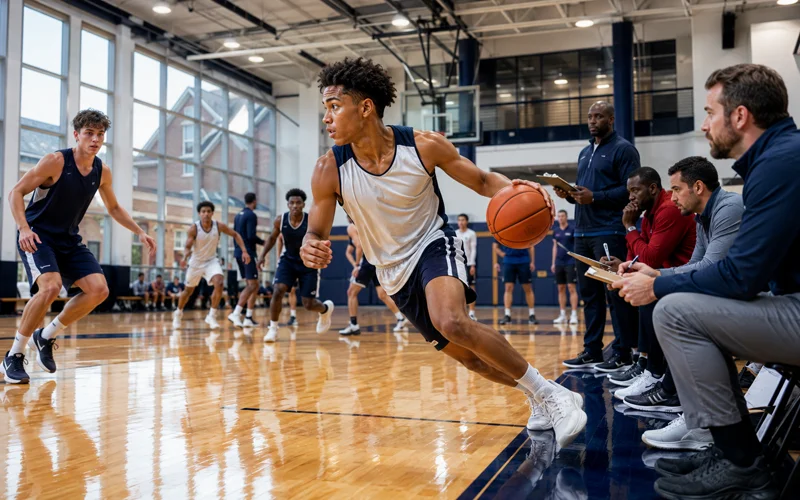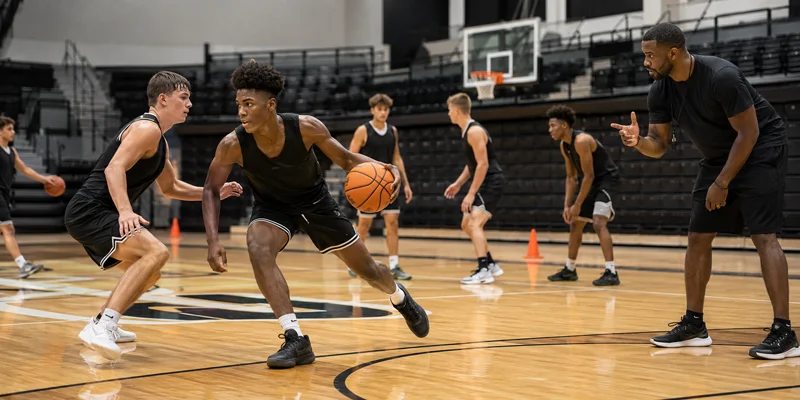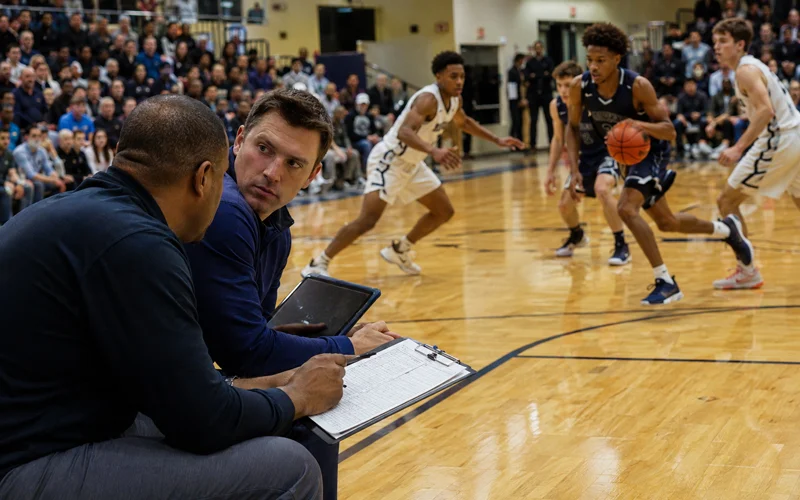
Parents and players often assume recruiting comes down to stats and a good highlight video. In practice, the players who actually get recruited are being watched a lot more closely, and for a lot longer, than a single mixtape suggests. Here’s what happens when a college coach scouts a prep school player.
It Starts With the NCAA Evaluation Period
College coaches can’t just show up to any game whenever they want. NCAA rules define specific recruiting windows, and the evaluation period is the one built for scouting: coaches can watch a recruit compete in person at a game, tournament, or school practice, but are generally restricted from having off-campus conversations with the player or family during that same window.
That’s distinct from the contact period, when direct communication is allowed, and the dead period, when no in-person recruiting activity happens at all. The NCAA’s evaluation period rules apply specifically to sports including Division I men’s and women’s basketball, which is why the biggest exposure events on the calendar tend to cluster around these windows.
What Coaches Are Actually Watching For
Physical Tools and Skill Translation
Size, athleticism, and coordination matter, but coaches are usually less interested in raw talent alone and more interested in how a skill set translates into a structured team system: can this player defend a position, execute in a half-court set, and make the right read under pressure, not just score in an open run.
Basketball IQ
Decision-making speed shows up constantly during a live evaluation: does a player make the extra pass, recognize a mismatch, or communicate on defense without being told. These moments are difficult to fake and are exactly why in-person scouting still matters more than film alone.
Body Language and Coachability
A recurring theme among college coaches is how much they read into body language: effort after a missed shot, reaction to being substituted out, response to being corrected mid-game. A player who visibly sulks after a mistake sends a very different signal than one who sprints back on defense regardless of the previous possession. Coachability, in particular, tends to be one of the most valued and most closely watched traits, because it predicts how a player will respond to four years of coaching at the next level.
Character, Family, and Off-Court Signals
Coaches are also, often quietly, evaluating the people around a recruit: how parents behave on the sideline, whether a player is respectful to officials and teammates, and how the family communicates during the process. This is one more reason a prep program’s leadership development isn’t incidental to recruiting; it directly shapes the signals coaches pick up on.
Academics
None of the above matters if a player can’t clear NCAA academic eligibility requirements. A program with a genuinely NCAA-certified academic structure and active GPA monitoring removes a real point of risk from a player’s recruiting profile.
How Prep Schools Fit Into the Scouting Process
A structured prep program does two things well: it gets a player in front of the right evaluators, and it puts them in game environments that mirror what a college coach is actually scouting for. At Bethel Academy, that happens through National, Regional, and Middle School rosters built around real competition, coached by a staff with direct ties to the Nike EYBL circuit, one of the most heavily scouted grassroots pipelines in the country. That combination of high-level competition and coaching credibility is a big part of why prep programs exist in the first place.
What This Means for Players and Parents
- Assume you’re being evaluated every time you’re on the court in front of a scouted event, not just during “big games.”
- Control what you can control: effort, communication, and body language, especially after mistakes.
- Keep grades and NCAA core-course requirements on track: it’s part of the evaluation, even if it happens off the court.
- Understand the recruiting calendar so you know when coaches are actually watching versus when they legally can’t reach out.
Next Steps
If you want a full breakdown of how to put yourself in front of the right coaches, read our guide on how to get recruited for college basketball, or learn more about the program structure at Bethel Academy in Manassas, VA.
Frequently Asked Questions
Do college coaches scout players in person or mostly through video?
Both, but in-person scouting during NCAA evaluation periods carries significant weight because it shows coaches how a player performs in real time, including intangibles that don’t always come through on film.
Can college coaches talk to players during an evaluation period?
Generally no. Off-campus communication is restricted during evaluation periods, though coaches can still watch and assess players in person.